
Beauty & Surgical-Grade Instruments for Tomorrow · OEM & Private Label · Worldwide Export

Send Inquiry
0%

Choosing Hair Cutting Scissors for Your Salon involves more than comparing prices, steel grades, or attractive finishes. The right pair should support precision, comfort, and consistent results throughout a busy working day. A stylist may open and close the blades hundreds of times during one shift. Small design differences can then become very noticeable.

Ivan Zoot, a respected barber educator and shear specialist, offers a useful principle: “The best shear is the one that fits your hand, your technique, and your work.” That idea deserves careful attention. A lightweight convex-edge shear may suit detailed dry cutting, while a stronger beveled-edge model may perform better for controlled wet cutting. Neither choice is automatically superior. Your cutting method matters.

Feel the handle.

Check the balance.

Notice the thumb ring.

A well-fitted handle can reduce awkward wrist movement when shaping layers around the ear or neckline. The blades should close smoothly, without pulling hair or producing a harsh metallic snap. Test the tension adjuster carefully. If it feels loose, stiff, or difficult to fine-tune, daily maintenance may become frustrating.

This guide will examine steel quality, blade design, handle shape, size, tension, and maintenance needs. It will also consider how different scissors perform on thick, fine, wet, and dry hair. A mistake is easy to make: choosing the most expensive pair and assuming it must be best. In practice, comfort and control often matter more than branding. Your ideal Hair Cutting Scissors should match your hands, your services, and the real pace of your salon.
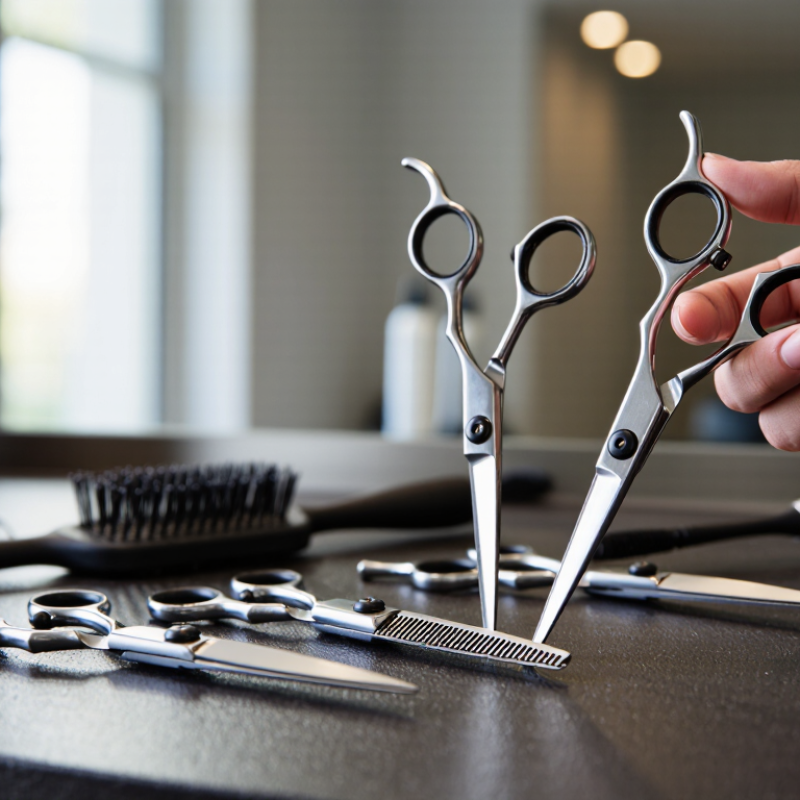
How to Choose Hair Cutting Scissors for Your Salon?

Understanding the Main Types of Hair Cutting Scissors

Choosing salon scissors starts with understanding what each type can actually do. Straight cutting scissors create clean lines for bobs, blunt cuts, and precise perimeter work. Their blades may be convex or beveled. Convex edges feel smooth and slice through hair, while beveled edges often provide stronger grip. Curved scissors follow rounded shapes around ears or layers, though they are less common for everyday cutting. In salon practice, comfort matters more than impressive specifications. A beautiful tool can still strain the hand.

Thinning scissors remove selected density without changing the outline dramatically. They suit heavy sections, soft blending, and controlled texture. Texturizing scissors usually have fewer, wider-spaced teeth, so they remove more hair per closure. That power needs restraint. One careless cut can leave a visible gap. Fine-tooth models create gentler refinement, while wider teeth produce a stronger effect. Offset handles can reduce wrist tension during repeated work. Still, posture and pressure matter just as much.

Tips: Hold each pair before buying. Check the balance, handle fit, blade alignment, and tension adjustment. Test the scissors on clean hair or a mannequin head. If the blades pull or fold hair, stop and reassess. I once focused too much on sharpness and overlooked handle comfort. That mistake became painful during a long cutting session. Clean and dry the scissors after use, then arrange professional sharpening when the cut starts feeling rough.

Matching Scissor Features to Salon Cutting Techniques

How to Choose Hair Cutting Scissors for Your Salon?

Matching Scissor Features to Salon Cutting Techniques

Choosing scissors should begin with your cutting method, not appearance. For blunt bobs, select sharp, stable blades with moderate tension. Their clean closure helps create a firm, even line. A shorter blade can improve control around the ears and neckline. It feels precise.

For slide cutting and soft layering, convex edges usually move smoothly through the hair. Longer blades can create broad, flowing sections with fewer hand movements. However, excessive length may reduce control on short cuts. For point cutting, a lighter pair with a sharp tip supports detailed texture. Serrated blades can grip slippery hair, but they may leave a harsher finish than expected.

In my salon experience, offset handles reduce wrist strain during repeated cutting. Swivel thumb designs can help stylists who change hand positions often. Tension matters too. If the blades fold hair, the setting may be too loose or the scissors may need servicing. I once blamed a tool for uneven ends, then found my sectioning was inconsistent. That mistake still affects my buying decisions. Test scissors on wet and dry sections before committing. Check balance, finger fit, and closing resistance. A comfortable pair encourages better technique, but it cannot replace disciplined training or regular maintenance.

Choosing the Right Size, Handle, and Blade Design

Choosing Hair Cutting Scissors for Your Salon

Scissor size should match the stylist’s hand, cutting method, and typical client service. A 5.5-inch pair offers control for precision work and short layers. Sizes from 6 to 7 inches usually support scissor-over-comb techniques and longer sections. Longer blades can reduce wrist movement, but they may feel awkward around the ears. Measure your palm and test the scissors before ordering several pairs. Comfort matters more than a popular size.

Handle design changes wrist position throughout a busy day. Offset handles can reduce thumb pressure during repeated cutting. A rotating thumb ring may help some stylists, though it is not comfortable for everyone. Hold the scissors with a relaxed grip and keep your elbow near your body. The movement should feel smooth. I once preferred a narrow handle, then noticed my hand tiring during detailed cuts. That experience changed my fitting process.

Blade design also affects control and texture. Convex blades often provide a smooth, clean cut with less pushing. Beveled blades offer dependable grip and may suit slide cutting or dry hair work. Choose a fine edge for precision, but check whether it needs frequent professional maintenance. Test the tension gently: the blades should close evenly without forcing them. A tiny adjustment can change the feel. My first fitting was too quick, and I missed that the finger ring was unstable. That mistake still influences every salon tool check.

How to Choose Hair Cutting Scissors for Your Salon?

Select the scissor size according to the cutting task: shorter blades provide better control for precision work, while longer blades cover more hair efficiently. Convex blades are commonly used for smooth, slide, and precision cutting, while beveled blades offer durability and a firm grip on the hair.

Handle guide: Offset handles generally reduce wrist extension during repeated cutting, while crane-style handles provide a more open hand position. Choose a size and handle that allow your thumb and fingers to move freely without excessive pressure.

Evaluating Material Quality, Sharpness, and Cutting Comfort

Choosing salon shears starts with material, not a polished finish. In daily use, high-quality stainless steel should resist corrosion, hold an edge, and remain stable after repeated cleaning. Harder steel can stay sharp longer, but it may chip if dropped or poorly maintained. That trade-off matters. Ask for clear information about steel grade, hardness, and manufacturing tolerances. Vague claims are not enough.

Sharpness should be tested on clean, dry hair rather than packaging paper. A precise blade should close smoothly, cut without folding strands, and leave a clean line. If the blades pull, crunch, or require force, the edge or tension may be wrong. Check the adjustment screw carefully. It should hold tension without feeling stiff. I once favored an extremely sharp pair, then noticed hand fatigue during long layered cuts. That was a useful correction.

Cutting comfort depends on balance, handle shape, finger rings, and weight distribution. The thumb should move freely while the wrist stays relaxed. During a fitting, open and close the scissors slowly for one minute. Notice pressure near the knuckles. A comfortable tool should support controlled movement, not force a fixed grip. Left-handed stylists need a genuinely mirrored design, not merely a reversed handle. Clean and oil the pivot according to the maker’s instructions, and inspect alignment regularly. Even excellent steel cannot compensate for poor maintenance.

How to Choose Hair Cutting Scissors for Your Salon? - Evaluating Material Quality, Sharpness, and Cutting Comfort

Evaluation Dimension What to Look For Recommended Standard Why It Matters in a Salon Suggested Weight
Material Quality Professional stainless steel or a corrosion-resistant alloy with consistent hardness and a smooth surface. Look for clear material specifications, precise finishing, and resistance to moisture, hair products, and routine disinfecting. Reliable materials help the blades retain their geometry and reduce the risk of rust, pitting, or premature wear. 25%
Blade Sharpness A clean, even edge that cuts hair smoothly without folding, pulling, or producing excessive pushing. Test on clean, dry hair or a suitable hair swatch. The blades should close smoothly from pivot to tip. A sharp, properly aligned edge supports accurate lines and reduces repeated passes through the same section. 25%
Edge Type Choose a convex edge for smooth slide cutting or a beveled edge for controlled, general-purpose cutting. Match the edge to the stylist's technique, cutting speed, and preferred level of hair control. The edge profile affects how the scissors move through hair and whether they feel more suitable for slicing or blunt cutting. 10%
Blade Alignment Blades should meet evenly without visible gaps, wobbling, scraping, or uneven contact. Open and close the scissors slowly and inspect the full cutting path from heel to tip. Proper alignment improves cutting consistency and helps prevent hair from being trapped between the blades. 15%
Cutting Comfort Balanced weight, smooth finger movement, comfortable handles, and an adjustable tension system. The scissors should open and close without excessive force while keeping the wrist in a neutral position. Good ergonomics can reduce hand fatigue during long appointments and repeated cutting motions. 15%
Size and Handle Fit Select a length that suits the hand size, cutting method, and service type. Common professional cutting lengths are approximately 5.0–7.0 inches; choose by hand fit rather than length alone. A suitable size improves control, reach, and comfort for detailed work or larger sections. 5%
Maintenance and Serviceability Adjustable tension, accessible pivot hardware, cleaning guidance, lubrication instructions, and professional sharpening support. Clean and dry after use, lubricate the pivot as recommended, and use a qualified sharpener when the edge becomes dull. Routine care protects the edge, maintains smooth movement, and extends the useful service life of the tool. 5%
Practical Selection Checklist: Test the scissors on an appropriate hair swatch, check blade alignment, confirm comfortable tension, inspect the handle fit, and verify that the tool can be cleaned, maintained, and professionally sharpened.

Checking Maintenance Needs, Safety, and Overall Value

Choosing salon scissors is not only about sharpness or cutting speed. Maintenance, safety, and long-term value deserve equal attention. In daily salon work, I check the pivot, blade alignment, finger rings, and tension control before judging performance. The U.S. Bureau of Labor Statistics projects 8% employment growth for barbers, hairstylists, and cosmetologists from 2022 to 2032. That means reliable tools may face heavy, repeated use. A smooth pivot matters when a stylist completes many cuts each day.

Maintenance should fit your real routine, not an ideal one. Scissors that require frequent professional adjustment may become expensive during busy weeks. Look for clear care instructions, corrosion-resistant construction, replaceable finger inserts, and accessible servicing. After each client, remove hair, clean the surface, and disinfect according to the manufacturer’s instructions. OSHA’s Hair Salons eTool stresses proper cleaning and disinfection for reusable, nonporous tools. Never assume wiping is enough. I once treated easy cleaning as a minor feature. It was not.

Safety also affects value. Handles should support a relaxed grip, while the tension system should prevent sudden blade movement. Test the scissors on a small section of clean hair. Watch for pulling, folding, or wrist strain. Poor balance can quietly cause fatigue. The U.S. National Institute for Occupational Safety and Health links repetitive work and awkward postures with musculoskeletal risk. A cheaper pair may save money today, but frequent sharpening, hand discomfort, and early replacement can change the calculation. Cost per working month is often more revealing than the purchase price.

FAQS

What type of scissors creates clean lines for blunt cuts?

Straight cutting scissors create crisp lines for bobs, blunt cuts, and precise perimeter work. Shorter blades improve control near ears and necklines. Choose moderate tension. Convex edges slice smoothly, while beveled edges often grip hair better.

What are thinning scissors used for?

Thinning scissors remove selected density without greatly changing the haircut’s outline. They work well on heavy sections, soft blending, and controlled texture. Use them carefully. Repeated closures in one area may create an unwanted gap.

How do texturizing scissors differ from thinning scissors?

Texturizing scissors usually have fewer, wider-spaced teeth. They remove more hair with each closure and create a stronger effect. Fine-tooth scissors provide gentler refinement. Wider teeth require restraint.

Which scissors suit slide cutting and soft layers?

Convex-edged scissors usually move smoothly through hair during slide cutting. Longer blades cover broad sections with fewer hand movements. However, long blades may reduce control on short cuts. That trade-off is easy to overlook.

What features help with point cutting?

A lightweight pair with a sharp tip supports detailed texture and controlled point cutting. Serrated blades can grip slippery hair. They may leave a harsher finish than expected. Test the result first.

How can a stylist check scissors before buying?

Hold the scissors and check balance, handle fit, blade alignment, and tension adjustment. Test them on clean hair or a mannequin head. Watch for pulling or folded hair. Stop and reassess.

Do offset or swivel handles reduce hand strain?

Offset handles can reduce wrist tension during repeated cutting. Swivel thumb designs may help stylists who change hand positions often. They are not magic. Posture and pressure still matter.

How should salon scissors be maintained?

Remove hair after each client, clean the surface, and disinfect reusable tools as directed. Keep the scissors dry to reduce corrosion. Check the pivot, alignment, finger rings, and tension regularly. Arrange professional sharpening when cutting feels rough.

How should a stylist judge the long-term value of scissors?

Consider cost per working month, not only the purchase price. Frequent sharpening, discomfort, and early replacement can increase the real cost. A cheaper pair may disappoint. I once focused on sharpness and ignored comfort. That was a painful mistake.

Conclusion

Choosing the right Hair Cutting Scissors is essential for achieving precise, comfortable, and consistent salon results. Start by understanding the main types, such as straight, thinning, texturizing, and curved scissors, then match each design to the cutting techniques you use most often. Consider the ideal size, handle style, finger comfort, and blade shape to ensure smooth control during detailed work or long cutting sessions.

Material quality, sharpness, and balanced construction also play an important role in performance. High-quality scissors should provide clean cuts without pulling or tiring the hand. Before making a purchase, evaluate how easily the scissors can be cleaned, adjusted, sharpened, and safely stored. A reliable pair should combine durability, ergonomic comfort, precise cutting, and reasonable long-term value, helping stylists work efficiently while maintaining professional results.

Clara

Clara

Clara is a professional marketing specialist with a strong understanding of the company’s products, their features, and the needs they are designed to meet. She regularly contributes expert articles to the company website, turning product knowledge and industry insights into clear, practical......