
Analyzing consumer trends, regional distribution challenges, and direct factory procurement advantages across Gauteng, Western Cape, and KwaZulu-Natal.
South Africa’s personal care and beauty industry has experienced unprecedented structural growth across major metropolitan hubs like Johannesburg, Cape Town, and Durban. With the expansion of boutique nail bars, mobile aesthetic franchises, and specialized manicurist training academies, the regional demand for high-durability 4-way and 3-way nail buffer blocks has surged. Salon owners require consumables that maintain abrasive structural integrity despite intensive daily exposure to acetone, sanitizing alcohols, and acrylic dust.
Historically, South African beauty distributors paid inflated markups to European and North American trading houses. Modern procurement strategies favor direct partnerships with Chinese primary manufacturers. By securing factory-direct FCL (Full Container Load) or LCL (Less than Container Load) shipments routed via the Port of Durban or Cape Town, importers reduce per-unit landed costs by up to 42%, securing superior gross profit margins while providing local salons with professional-grade buffers.
Understanding abrasive mineral coating, core foam density ratings, and non-delaminating adhesive chemistry.
A professional nail buffer block is not merely a block of foam; it is a multi-layered precision instrument engineered for specific keratin and artificial polymer work. Subpar wholesale buffers often suffer from rapid grit peeling, uneven foam compression, and premature breakdown under friction heat. Premier Chinese manufacturing processes resolve these engineering defects through rigorous raw material selection.
E-E-A-T Manufacturing Note: High-grade EVA (Ethylene-Vinyl Acetate) foam cores manufactured with a 45 to 60 Shore C hardness index provide the ideal modulus of elasticity. This ensures the buffer conforms around the natural nail plate radius without applying excessive localized pressure that can tear the delicate hyponychium.
| Grit Matrix | Abrasive Material | Surface Function | Ideal Application Scenario | Substrate Core Type |
|---|---|---|---|---|
| 60 / 80 Grit | Black Silicon Carbide | Heavy Material Removal | Acrylic & Hard Gel Extension Shaping | High-Density Plastic Center + Rigid EVA |
| 100 / 150 Grit | Premium Aluminum Oxide | Sidewall & Free Edge Refinement | PolyGel Contouring & Tip Blending | Flex 45 Shore C White EVA Core |
| 180 / 240 Grit | Electro-Coated White Corundum | Natural Nail Preparation | Removing Natural Oils prior to Gel Polish | Soft Cushion Elastic Memory Foam |
| 400 / 1000 Grit | Micro-Crystalline Silica | Smoothing & Ridge Filling | Natural Nail Buffing & Surface Prep | Ultra-Fine Flexible Sponge Base |
| 3000 / 4000 Grit | Nano-Polymer Buffer Film | High-Gloss Glass Friction Shine | Natural Polish-Free Manicures (Shine Finish) | Ultra-Soft Compressible Foam Core |
Essential compliance protocols, HS tariff classification, and shipping schedules for importers in Joburg, Cape Town, and Durban.
Nail buffer blocks imported into South Africa fall under HS Code 6805.20 (Natural or artificial abrasive powder or grain, on a base of paper or paperboard only) or HS Code 6805.30 (on a base of other materials). Importers must ensure correct clearance documentation to comply with SARS (South African Revenue Service) customs regulations, avoiding port detention delays.
Primary sea shipments depart from Ningbo, Shanghai, or Shenzhen directly to ocean hubs:
• Port of Durban: 18 - 22 Days (Ideal for Gauteng rail/truck freight transfer).
• Port of Cape Town: 24 - 28 Days.
• Port of Gqeberha (Port Elizabeth): Serving Eastern Cape distributors.
South Africa’s diverse climatic conditions—from humid coastal Durban to dry inland Highveld (Johannesburg)—demand robust packaging. Our factory utilizes moisture-impermeable heat-sealed poly packaging with silica desiccant inserts, preventing humidity-induced adhesive softening during container transit.
Transforming raw buffer blocks into private-label retail collections for South African cosmetic brands.
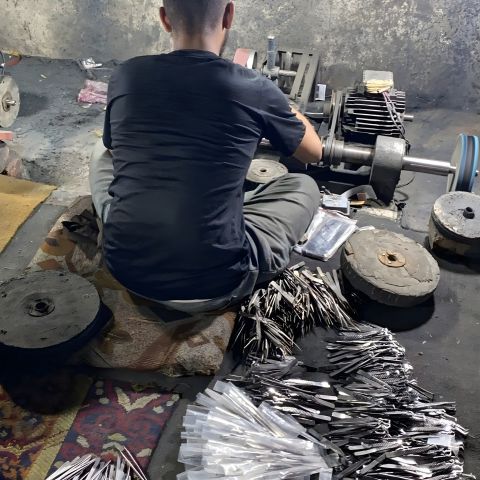
Synthesizing traditional finishing expertise with modern automated abrasive lamination, our manufacturing operations deliver uncompromised consistency across million-unit orders. Each batch undergoes rigorous quality control to ensure tip alignment, grit retention, and structural resilience.
Addressing import duties, custom branding minimums, sample validation, and regional delivery logistics.
Our standard MOQ for custom-printed nail buffer blocks (with customized foam colors, grit configurations, and branded logos) starts at 3,000 units per specification. For standard stock buffer block colors with black silk-screen logo printing, we offer flexible starter MOQs starting at 1,000 units to accommodate emerging South African distributor brands.
We utilize specialized medical-grade polyurethane cross-linking adhesives to bond the abrasive sand paper to the high-density EVA foam core. This advanced bond resists breakdown when subjected to 70% Isopropyl Alcohol spray, hospital-grade surface disinfectants, or brief warm-water rinsing cycles, allowing South African salon professionals to sanitize tools without layer delamination.
We issue a comprehensive export documentation package tailored to South African SARS requirement standards. This includes the Commercial Invoice, Packing List, Bill of Lading (B/L), Certificate of Origin (Form F or General COO), and material safety datasheets (MSDS) confirming non-toxic chemical compliance for all foam and adhesive components.
Yes. We strongly encourage pre-production sample evaluation. We dispatch sample kits featuring various grit combinations (e.g., 80/100, 180/240, 3000 shine blocks) and core densities via DHL or FedEx Express directly to your office in Johannesburg, Cape Town, Pretoria, or Durban within 5 to 7 business days.
Our standard international B2B trade terms are T/T (Telegraphic Transfer): 30% deposit upon order confirmation and artwork sign-off, with the remaining 70% balance payable against presentation of the Bill of Lading copy. Confirmed Irrevocable Letters of Credit (L/C at sight) are also accepted for high-volume annual supply agreements.
Direct factory sourcing eliminates 30% to 50% in middleman distributor surcharges, grants full control over grit engineering and private labeling, and guarantees fresh inventory with maximum foam elasticity—preventing the brittle foam degradation often found in aged warehouse stock.